SEVERE OSTEOARTHRITIS AND DIFFICULTY STANDING UP
Riser recliner chair for severe osteoarthritis: standing up and sitting back down with more control
A riser recliner chair for severe osteoarthritis should make everyday moments more comfortable: standing up, sitting back down, reading and resting. When the knee, hip, spine or hands are involved, needs can change even within the same day. Well-proportioned measurements, supports close by and simple adjustments help in choosing a place that suits the habits of the person.
Sollevita is a riser recliner chair with integrated care features, made in Italy by La Castellana. It brings together adjustments for comfort, sit-to-stand assistance and functions for care and transfers. Its contribution concerns these movements; the treatments and the exercise recommended for osteoarthritis remain part of the individual pathway.
Sollevita is also designed for people who walk, are independent and want more everyday wellbeing. It is not reserved for the most severe forms: a welcoming seat, leg support and help with rising are valuable even when they are needed only at certain moments. Measurements are chosen and functions are used according to your own needs.
On this page
- Severe osteoarthritis: the choice starts from daily activities
- Knee and hip: why standing up can become difficult
- Height and depth must prepare the movement
- The rise function accompanies both standing up and sitting down
- Painful hands, armrests and handset
- Better and worse days: adjusting the level of help
- Movement and rest must stay in balance
- Tilt-in-space, Zero Gravity and the lie-flat position
- Table, wheeled base and bed-to-chair transfers
- Carers and vertical height adjustment
- After hip or knee surgery: following the guidance given
- The eight Sollevita functions, already integrated
- Upholstery and support in everyday life
- What to tell the Sollevita Team before the consultation
- Answers on supports, rising and resting with osteoarthritis
Severe osteoarthritis: the choice starts from daily activities
The severity of osteoarthritis is assessed within the clinical pathway; in choosing a chair, everyday experience counts too. How demanding is standing up? How does the return to the seat happen? Which supports are comfortable? These questions connect the diagnosis with activities, without replacing clinical assessment.
Two people with osteoarthritis in the same knee can have different needs. One may walk but struggle to get up from a low chair; another may feel discomfort after sitting for a long time; another may also have painful hands and find it hard to push up on the armrests. These are situations to describe, not levels of care to be assigned automatically.
That is why a chair for osteoarthritis should be compared with the concrete movement. Difficulty in standing up does not on its own demonstrate the presence or the severity of osteoarthritis. If the cause of the pain has not been clarified, the point of reference is clinical; if guidance on activities already exists, it helps in assessing measurements and functions.
Knee and hip: why standing up can become difficult
The move from sitting to standing involves foot support, movement of the trunk and work by the legs. With osteoarthritis of the knee, also called gonarthrosis, or of the hip, called coxarthrosis, pain and stiffness can make this sequence more demanding. How it actually works cannot be derived from a foot position or an angle that is the same for everyone.
A low seat can require more movement and effort to reach standing; a deep seat can force the person to shuffle a long way forward before finding useful supports. A surface that gives way a great deal can also make it hard to prepare the movement. The problem therefore cannot be reduced to height alone.
Describing where the difficulty appears helps in choosing: in the preparation, while leaving the seat, or when sitting back down. There is no need to repeat a painful movement to show it. Everyday observations make it possible to focus on the transition that counts.
A riser recliner chair for osteoarthritis offers mechanical help to build into everyday transitions, keeping the supports and equipment already in use. The guidance received governs how to sit down and stand up; the Sollevita Team explains how the adjustments can accompany it.
Height and depth must prepare the movement
A higher seat does not always help. If it is too high, the feet can lose stable support; if it is too deep, the back can stay far from the backrest. Height, depth, width and the position of the armrests should therefore be considered together, looking at rest as well as at preparing the rise.
Sollevita offers seats 52 or 63 cm wide and three depths. The depth is set through the positioning of the backrest, while the footrest extension widens the support available for taller people. The choice is not about preferring the larger size, but about finding proportions that suit the body and the activity.
The three-layer seat construction combines a sprung seat base, individually pocketed springs and an upper comfort layer. The high backrest and Push Head complete the supports. Construction matters, but how soft it feels in the first minute is not enough to know whether getting back to standing will be easy.
Consider any cushions already prescribed for the person too: they are part of the surface actually used. Do not try to correct a measurement with stacked cushions or improvised risers. Bring the information available and the difficulty you have found to the consultation instead.
To compare proportions, construction and adjustment options, look further into the construction and functional differences of Sollevita. The comparison must concern the actual configurations, not just the number of motors.
The rise function accompanies both standing up and sitting down
The rise function brings the pelvis progressively upwards and forwards, carrying out part of the movement mechanically. It can be stopped along the way. The adjustment makes it possible to use the help that suits the transition, with the supports and the assistance planned for the person.
For someone with osteoarthritis of the hip or the knee, the benefit concerns the moment they leave the seat: part of the movement is carried out by the chair, instead of depending entirely on the push of legs and arms. This help should not be confused with treating pain or with a reduction in joint load that is the same for everyone.
Used in reverse, the function can also accompany the return to the seat. This movement is not a system that recognises or catches a fall: balance, preparation and the help required keep their own role.
The rise function should not be confused with vertical height adjustment, which changes the height of the whole structure with the person seated or lying down. The two functions answer different tasks. If moving into standing is not appropriate, increasing the rise does not replace a transfer with the equipment indicated.
Painful hands, armrests and handset
When hands, wrists or shoulders are painful too, pushing up on the armrests can become difficult. The supports must be within reach and well proportioned, without obliging the person to carry the whole work of rising with their arms. The powered movement can help with that transition, but it should be assessed together with the seat.
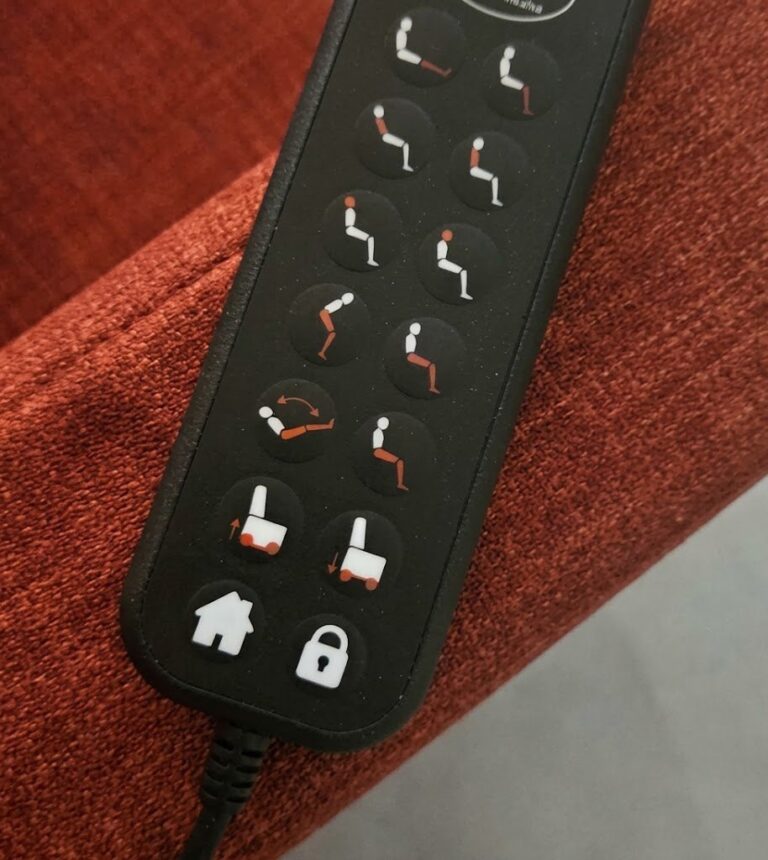
Sollevita handsets are designed for simple use, with intuitive buttons and a logical layout. Corded and wireless versions are available: together with the Sollevita Team, choose the one that is most convenient for your habits and for the configuration.
When the fingers or the base of the thumb are painful, placing the control close by and resting the forearm comfortably can make it more practical to manage. These points are agreed with the Sollevita Team, without asking the hands for uncomfortable movements or assuming the same needs for everyone.
The explanation starts from the functions you want to use and involves whoever helps you, where needed. Tutorials and support by video call remain available to clarify a step after delivery as well. The choice between a corded and a wireless handset completes this attention to comfortable use.
Better and worse days: adjusting the level of help
Pain and stiffness can vary. A person may need more help after a break, at a particular moment or on a harder day. There is, however, no morning-evening rule that applies to everyone, and no chair position to be linked automatically to the intensity of pain.
The independent adjustments make it possible to choose the setting and the support that are useful at the time. The measure is receiving the help that is needed while keeping the participation that is possible and wanted, without removing supports in order to demonstrate independence.
A sudden increase in pain, significant swelling, new instability or loss of function should not be put down automatically to osteoarthritis. That calls for prompt clinical advice, not only a different adjustment. A sales consultation does not replace that assessment.
Movement and rest must stay in balance
A comfortable break and appropriate movement both have a place in the same day. The adjustments accompany rest; activities and any exercises agreed with the professionals involved keep their own role. The chair fits into this balance, without becoming a rehabilitation programme.
Receiving help to stand up and living independently are not in contradiction. Sollevita leaves room for comfort and for the activities you prefer, while the rise function accompanies the transition where a hand is needed. The exercises and the movement indicated by professionals keep their own role.
A relaxing chair for osteoarthritis should be pleasant during the break and in the return to activity. Choosing the supports, keeping the handset close by and arranging any help make it more comfortable to move from reading to rest and then back to sitting.
How long the break lasts and how often positions change follow the habits and the guidance for the person. When discomfort increases, it is important to listen to it and clarify how to continue, rather than persisting in an uncomfortable position.
Tilt-in-space, Zero Gravity and the lie-flat position
Tilt-in-space tilts seat and backrest together, keeping the angle between the two parts. Backrest recline, on the other hand, changes the angle of the backrest in relation to the seat. These are different possibilities: they make it possible to assess resting supports without always having to reach the widest opening.
Moving the structure does not mean repositioning the body automatically. If the pelvis has slid or a support is no longer adequate, the care procedures planned should be followed. The motor is not used to force a knee into extension or to find, by trial and error, a movement that causes pain.
The powered headrest Push Head adjusts the support for head and neck. Together with the high backrest it offers support while reading or watching television, in the positions that are comfortable for the person. Where a specialist support is planned, it remains part of the assessment.
Zero Gravity combines tilt-in-space, backrest and footrest into a relaxed setting with legs and feet raised. The position is assessed in relation to comfort and individual guidance: it is not a treatment for osteoarthritis or for joint pain.
The lie-flat position (180°) makes it possible to stretch out for a break in the same place, where appropriate. It is a possibility, not a goal to reach every time. Intermediate positions remain important if they are the ones indicated or preferred; the function does not make the chair a universal substitute for the bed.
Table, wheeled base and bed-to-chair transfers
The day is not made only of rising and resting. Sitting at the table, talking with the family or reaching another room can be concrete reasons to assess the place. The point is keeping the activity you want, not avoiding every move as a matter of principle.
The removable upper armrest section reduces the space taken up so that Sollevita can be brought closer to a compatible table. Table legs, room for knees and feet and the supports required also need to be considered. If an armrest serves as support for sitting down or standing up, it must be present in the configuration planned for that movement.
The sturdy wheeled base makes it possible to accompany the person between the different rooms of the home while they stay seated, even when the route is longer. To reach the bedroom or the living room there is therefore no need to change seat just to move. Use remains indoors and follows the conditions of the route and the product instructions. The battery powers the adjustments, not the drive of the wheels.
Lateral transfer can become relevant when osteoarthritis coexists with other difficulties and a wheelchair or other equipment is used. The fully removable side panel frees up access and vertical height adjustment sets the height. The lie-flat position adds a flat surface for the uses planned, but it is not necessary for every move from the wheelchair.
Where a transfer board, a sling, a patient hoist or personal assistance are needed, these remain part of the assessment. Having a free side does not demonstrate compatibility with every piece of equipment and does not determine the transfer technique.
Carers and vertical height adjustment
Vertical height adjustment raises or lowers the whole structure while the person stays seated or lying down. It can bring them to a more favourable height for adjusting clothing, helping with dressing or carrying out other compatible care activities. The removable side panel makes it possible to assess side access as well.
Being able to come closer and work at a more comfortable height helps in organising care with less bending and less reaching. The adjustments are used together with the care procedures already indicated, keeping the supports of the person in place.
It is worth clarifying who manages the control and how a pause is signalled. The person using the chair should stay involved even when they are not pressing the handset themselves. The comfort of the carer and that of the person should be considered together.
After hip or knee surgery: following the guidance given
The choice for osteoarthritis and the choice after a hip or knee replacement are not automatically equivalent. After surgery, heights, movements, weight-bearing on the leg and the way of sitting down or transferring follow the orthopaedic and rehabilitation guidance received.
Precautions read for another operation are not transferred to your own situation. If a restriction is unclear, ask the professional how to apply it to the seat and the adjustments. The rise movement does not cancel a weight-bearing restriction and does not authorise exceeding the range of movement allowed.
The Sollevita Team can provide measurements and a description of the movements to compare with that guidance. Having the lie-flat position or an adjustable height available is technical information, not an automatic confirmation of suitability after surgery.
The eight Sollevita functions, already integrated
Sollevita is a single complete model. The drive system includes between 5 and 8 independent motors, depending on the user weight rating. The eight main functions are part of the same design and make it possible to assess rising, resting and care activities in the same chair.
- Rise function — Progressively accompanies the move towards standing and, in reverse, the return to sitting.
- Relax — Adjusts backrest and footrest to choose a position for reading, television or a break, including intermediate positions.
- Powered headrest Push Head — Adjusts the support for head and neck in the different positions.
- Tilt-in-space — Tilts seat and backrest together, keeping the angle between the two parts.
- Zero Gravity — Combines tilt-in-space, backrest and footrest into a relaxed setting with legs and feet raised.
- Lie-flat position (180°) — Brings the chair into a flat position for a break or a rest, where appropriate for the person.
- Vertical height adjustment — Raises or lowers the whole structure with the person seated or lying down, setting the height for care or for coming alongside other surfaces.
- Lie-flat transfer configuration — Combines flat surface, vertical height adjustment and removed side panel to prepare the approach to the bed and some transfers.
The design is completed by the three-layer seat construction, the high backrest, the footrest extension, the removable upper armrest sections, the removable side panel, the lithium battery and the wheeled base. Removable outer and underlying covers and the modular construction concern the care of the upholstery and the components over time.
See functions, measurements and price of Sollevita to look further into the configuration. Completeness offers more possibilities to assess, without obliging you to use every function.
Upholstery and support in everyday life
When the chair is used every day, how its parts are handled matters too. On Sollevita both the outer and the underlying covers are removable. Raggio di Sole and Mons fabrics and the faux leather keep their own care instructions; being removable does not make every cleaning method the same.
When hands or shoulders are painful, it is worth agreeing who will take care of the everyday work on the covers. The modular construction allows targeted work on the components by people with the right skills. For any questions, the Sollevita Team remains the point of contact for the product.
The five-year commercial warranty, original spare parts, tutorials and video calls complete the relationship with the manufacturer, according to the conditions of purchase. On the Warranty & Service page you will find cover and arrangements for direct support. If supports, the ability to use the control or transfers change over time, how the chair is used should be reassessed as well.
What to tell the Sollevita Team before the consultation
Tell us which joints are involved and at which moments you would like more comfort: standing up, sitting back down, reading or resting. Height, weight, your current seat and the equipment you usually use allow the Sollevita Team to connect measurements and functions with your needs.
You can add a photograph of the empty space and the measurements available, together with the guidance you have received. We can also talk about the handset you prefer and who will use it, without asking for painful trials or clinical documentation that is not needed.
Explaining the product helps you recognise the adjustments; any personal trial concerns the activities that are appropriate. The aim is a clear and comfortable choice for your day, not proof that you can manage every movement.
3 steps to define the perfect Sollevita for you
Sollevita comes fully equipped for home care. Our job is to understand whether it can meet your needs and to guide you clearly before, during and after delivery.
Tell us about yourself
Tell us about your needs, or those of the person who will use Sollevita. Height, weight, hours spent in the chair, level of independence and daily needs help us understand how the product will be used every day.
Let's assess together whether Sollevita is right for you
The Sollevita Team listens to your needs, explains every function and assesses sizes, weight capacity and how the chair will be used. We explain precisely whether and how Sollevita can meet the needs of the person and their daily life.
Delivery and support
We arrange delivery and a complete explanation of the product, so that you get to know all of Sollevita’s functions and use them correctly. After purchase, the Sollevita Team remains your direct point of contact for warranty, spare parts, tutorials, video calls and technical support over time.
Next step
The right choice starts with a conversation
For such an important choice, talk to the people who make it. Write to us: you will get a reply directly from the Sollevita Team, not a call centre. Our consultants know the chair inside out, from its mechanisms to its adjustments, and they listen to you to offer clear explanations, technical expertise and personalised advice.
- Free consultation
- Reply within 24 hours
- Direct contact with the manufacturer
FREQUENTLY ASKED QUESTIONS
Answers on supports, rising and resting with osteoarthritis
The joints involved and the activities of the person count for more than a measurement that is the same for everyone. These answers help in assessing how seat and adjustments can accompany everyday movements.
When can the rise function help with osteoarthritis of the hip or knee?
It can help when pain and stiffness make the move from sitting to standing demanding. Sollevita guides the pelvis progressively and allows the movement to be stopped. To choose a chair for severe osteoarthritis, measurements, supports and assistance need to be assessed too. The powered help carries out part of the movement, but it does not treat the condition and does not guarantee any specific reduction in joint load.
Is a higher, softer seat always the better choice?
No. A seat that is too high can make foot support less stable; one that is too deep can prevent you reaching the backrest. Softness alone does not describe how easy it is to prepare the rise. Sollevita offers two widths and three depths, to be considered together with the supports. The aim is a well-proportioned seat, not automatically the largest or the softest.
Is the powered help useful when sitting back down is difficult too?
Yes, where an assisted return is appropriate for the person. The reverse movement can gradually accompany the descent with the supports and the help required. It does not recognise or catch a fall. This mechanical option should be distinguished from treating pain and from assessing any problem with balance.
What should be considered when hands or shoulders make pushing up hard?
The rise function carries out part of the movement so that not everything depends on pushing with legs and arms. The armrests remain supports to be proportioned to the person. For the adjustments, Sollevita offers handsets with intuitive buttons, corded or wireless: the Sollevita Team helps in choosing the most convenient solution, taking into account any hand pain and the assistance available.
How can a resting position be found without straining the joints?
The adjustments allow intermediate positions: there is no need to reach the lie-flat position (180°) or Zero Gravity. Backrest and footrest adjust separately; tilt-in-space tilts seat and backrest together. The position must respect the supports and the guidance received. If the movement causes pain, it is stopped and the difficulty clarified, without using the motor as a stretching exercise.
Is Sollevita useful for independent people who mainly want comfort?
Yes. Sollevita is also designed for people who walk and want a quality seat, adjustable supports and resting positions. The rise function is used for the transitions where help is needed, without being compulsory every time. Everyday comfort sits alongside the activities and the movement agreed with the professionals involved.
When might side access and vertical height adjustment be needed?
They can be useful when moving between bed, wheelchair and chair calls for a different height or a free side. The removable side panel and vertical height adjustment prepare these elements; the lie-flat transfer configuration adds the flat setting where appropriate. Technique and compatibility with any boards or a patient hoist need to be checked. The lie-flat position (180°) is not automatically required for every transfer.
Do the same criteria apply after a hip or knee replacement?
Not automatically. Measurements and supports remain important, but use must respect the guidance received after surgery. Ask which movements, heights and transfer methods are appropriate and compare them with the features of the chair. The motor does not cancel any weight-bearing or movement restrictions, and having a function available is not permission to use it.