
STROKE, HEMIPARESIS AND EVERYDAY LIFE
Riser recliner chair after a stroke: seating, rising and transfers
Choosing a chair after a stroke means looking for comfort and support in everyday actions: sitting, resting, reading or moving from the bed to the chair. Arm, leg and trunk control may each call for different attention. That is why the choice considers seat, supports, adjustments and the help available as a whole.
Sollevita is a riser recliner chair with integrated care features, made in Italy by La Castellana. It brings together resting positions, sit-to-stand assistance, vertical height adjustment and side access. These functions fit into the habits of the person and work with the equipment already in use, respecting the guidance given by rehabilitation.
Sollevita is also designed for people who walk and are independent but want a more comfortable seat or help with some transitions. Everyday wellbeing is not only about care: being comfortable during a conversation, reading with the supports you want and choosing how to rest all matter too. The chair offers support with activities, without treating the effects of a stroke.
On this page
- After a stroke, the weaker side does not describe everything
- A chair after a stroke should offer stability without forcing symmetry
- Standing up and sitting back down with graded assistance
- Supporting the affected arm during seating and transfers
- Lateral transfer: choosing side and height
- Bed to chair and chair to bed: height difference and side access both count
- Intuitive handsets and communication after a stroke
- Resting, Zero Gravity and the lie-flat position
- Carers, wheeled base and other equipment
- Sitting at the table and taking part in life at home
- The eight Sollevita functions, already integrated
- From rehabilitation guidance to assessing Sollevita
- Answers on supports, rising and transfers after a stroke
After a stroke, the weaker side does not describe everything
Hemiparesis describes reduced strength on one side, but in daily life the picture can also include reduced sensation, unsteady balance, less trunk control, spasticity, visual difficulties or inattention to one part of space. Two people with the same side affected can therefore have completely different needs.
One person may have a weaker leg but hold the trunk well. Another may have enough strength and yet not perceive the position of the foot or the arm correctly. Another may find it hard to organise a movement or to follow a complex sequence. The chair should be assessed within this picture, not only on the power of the motor.
The choice starts from how the person moves today and from the guidance received. Describing a concrete wish, such as talking in the living room with the arm supported, helps to identify the features that will be useful. The access side and the assistance are then agreed around the individual situation.
A chair after a stroke should offer stability without forcing symmetry
After a stroke the body may lean more on one side, the pelvis may rotate and the trunk may need different support. The seat must offer a stable and sufficiently welcoming base, but on its own it cannot correct a neurological asymmetry or replace a specialist postural system.
A seat that is too wide can move the armrests away; a seat that is too deep can make it hard to reach the backrest and prepare the rise. Sollevita offers a seat 52 or 63 cm wide and three depths, obtained through the positioning of the backrest. Width, depth and height should be considered together with foot support and the position of the arms, rather than simply choosing the larger size.
The three-layer seat construction combines a sprung seat base, individually pocketed springs and an upper comfort layer. The high backrest supports the back; the powered headrest Push Head adjusts the support for head and neck at different angles. Their value should be read within the seat as a whole, not as an automatic correction of body control.
Any cushions or supports already prescribed are part of assessing the new chair: they should not be removed to obtain an apparently more symmetrical position. Greater softness or a narrower seat do not replace that discussion. To look further into how supports, adjustments and access are built, you can compare the construction and functional differences of Sollevita.
Standing up and sitting back down with graded assistance
Standing up involves feet, legs, pelvis and trunk. After a stroke the movement can be slower, asymmetrical or need assistance. A riser recliner chair after a stroke should accompany the transition while keeping the supports and the help that have been indicated, including the return to sitting.
The rise function progressively guides the pelvis upwards and forwards and can be stopped along the movement. Whether it can be used depends on the ability of the person to take part in the movement, on the equipment and on the help planned. The point at which to stop is not chosen simply by watching how far the seat rises.
Where the person follows a rehabilitation programme, use of the chair must respect its guidance. The powered movement is mechanical help, not an exercise in recovery in itself. Assistance is not reduced in order to practise during a demonstration, and the rise is not increased to try to compensate for any difficulty in bearing weight.
The return to sitting deserves attention too. A person may manage to stand up and yet find it difficult to control the last few centimetres of the descent. Used in reverse, the rise function can accompany the return, with the supports and the assistance required. It accompanies a planned movement: it does not detect a fall and does not replace balance, orientation or supervision where these are needed.
Supporting the affected arm during seating and transfers
When the arm is weak, painful or poorly controlled, supporting it deserves attention even during short transitions. The carer follows the guidance of the professionals involved and does not use the limb to pull the person upwards or sideways. New pain should be reported, rather than dealt with by changing grip.
The armrest can offer support while seated. When a lateral transfer is being prepared and the armrest has to be removed, the support the arm needs must be maintained through the different phases of the move. Freeing up the side and supporting the limb are two things to organise together.
On Sollevita the removable side panel makes it possible to set up side access. It does not, however, replace a specific arm support or the way of accompanying that has been taught. During the assessment, consider arrival on the seat as well: where the limb will rest, which elements must stay fitted and what help will be available for settling in.
Lateral transfer: choosing side and height
There is no universal rule by which every transfer after a stroke must always happen from the so-called unaffected side. Strength, sensation, pain, spasticity, attention to space, the environment and the equipment all contribute to the approach indicated by the professionals involved. The side affected by the stroke does not on its own decide the direction.
Sollevita allows the whole side panel to be removed and the height of the structure to be set with vertical height adjustment, preparing access according to the procedure already defined. Vertical height adjustment keeps the person seated or lying down while the height changes: it is not the same as the rise function, which accompanies the move towards standing.
Bringing surfaces closer or reducing a height difference does not automatically make the move appropriate. The parts that must remain accessible, the supports of the person and the space for the carer all need to be considered. Where boards, slide sheets, slings or a patient hoist are planned, their compatibility with the actual configuration must be checked. The presence of a removable side panel is not enough to confirm it.
Bed to chair and chair to bed: height difference and side access both count
The transfer from bed to chair is not identical to the return from chair to bed. The side available, the height of the surfaces, trunk control, foot support and the position of the affected arm can all change between the two directions. The assessment must therefore include how the chair will be left, not only how it is reached.
Combining the lie-flat position (180°), vertical height adjustment and the fully removable side panel makes it possible to set up a flat surface, change its height and free up side access. That is the configuration behind the lie-flat transfer function: it can make coming alongside the bed easier and help prepare some transfers, without requiring a move into standing.
The discussion starts from the bed and the equipment actually used. A photograph of the empty spaces and the measurements available can make clear which technical information is missing; there is no need to have a transfer repeated to show the problem. Explaining the product and assessing the move with the person have different purposes.
Where the person has to be fully supported, the equipment and the assistance indicated remain necessary. Sollevita can make height and access more favourable, but it does not become a patient hoist or a universal medical stretcher. The correct setting of the base must also be prepared according to the instructions before every move.
Intuitive handsets and communication after a stroke
Sollevita handsets are designed for simple use, with intuitive buttons in a logical layout. Corded and wireless versions are available: the Sollevita Team helps in choosing the one that suits the configuration and the habits of the person.
After a stroke, needs around using the controls may concern the hand, attention or communication. Neglect can make one part of space less apparent; aphasia can affect expression or understanding; apraxia can make it difficult to organise a movement. These conditions are not necessarily present together and call for explanations consistent with the guidance received.
Difficulty in expressing oneself does not, on its own, show that the person does not understand what is happening. Allowing the time and the means to indicate a preference or ask for a pause keeps the person at the centre, even when someone else operates the handset.
Choosing the handset also covers where to place it and whether help from a carer is needed. There is no side that is automatically right for everyone: the hand being used, the supports and attention to space guide the arrangement, together with the professionals involved where necessary.
The Sollevita Team shows the adjustments calmly and remains available with tutorials and support by video call. A simple control makes the product easier to get to know; any assistance follows individual needs.
Resting, Zero Gravity and the lie-flat position
A break in the living room can mean being with the family, listening to the television or resting in the same place. To choose a relaxing chair after a stroke, though, what counts is how the body and the limbs are supported during the move into the position you want, not only how far the backrest goes down.
Tilt-in-space tilts seat and backrest together, keeping the angle between the two parts. Backrest recline, on the other hand, changes the angle of the backrest in relation to the seat. These adjustments offer different possibilities, but they do not automatically straighten a leaning trunk and they do not reposition a pelvis that has lost its support.
Zero Gravity offers a relaxed setting with legs and feet raised, to be assessed in relation to comfort, supports and individual guidance. There is no need to reach the maximum angle. It is not a position for treating hemiparesis or spasticity, nor for promoting recovery after a stroke.
The lie-flat position (180°) brings the chair into a flat position for a break or a rest, where appropriate. The movements also allow stopping at intermediate positions. This possibility does not automatically replace the bed for the night or the specific surfaces planned as part of care.
Rest should also leave room for the return to activity. Finding support for the arm again, the handset close by and the help planned all make the move to conversation or to another place calmer. Duration and changes of position follow the needs of the person.
Carers, wheeled base and other equipment
Vertical height adjustment can bring the person to a more favourable height during dressing, shaving, hair care, adjusting clothing or other compatible care activities. The removable side panel allows the carer to come alongside. The chair does not remove the physical demands of care, but it can reduce some unnecessary bending and reaching.
The sturdy wheeled base makes it possible to accompany the person between rooms of the home while they stay seated, including on longer routes. It is a concrete way of reaching the room you want without arranging a change of seat every time. Route and accompaniment follow the product instructions; the battery powers the adjustments, not the drive of the wheels.
Moving in the chair requires an accompanying person and sits alongside the other ways of getting around the home. Anyone who uses a wheelchair independently keeps that freedom; anyone who walks continues with the activities that are appropriate. The most useful solution is chosen for the moment, without giving up what already works.
Everyday management also includes covers and components. Both the outer and the underlying covers are removable; the modular construction makes it easier to work on the individual elements provided. Cleaning and maintenance follow the product instructions, without turning a carer into a technician.
When several family members take turns, it helps if they know the same functions and the same points of contact. On the Warranty & Service page you will find the conditions of the five-year commercial warranty, the spare parts and the direct support of the Sollevita Team. Continuity of service completes the choice, without replacing individual care guidance.
Sitting at the table and taking part in life at home
The chair is also the place where you read, talk with the family or take part in a shared activity. A comfortable view and support for the arm and the trunk are part of these moments, not only of transfers.
To come closer to a compatible table, the upper part of the armrest can be removed on Sollevita. That is a different operation from removing the whole side panel for a transfer. Coming closer should be considered together with support for the arm and the trunk, not only with the space available under the surface.
Where there are swallowing difficulties, the position for meals and the assistance follow the guidance received. Conversation and relaxation do not necessarily require the same supports as eating. The adjustments, including Push Head, are used in line with that guidance and do not replace swallowing strategies.
The eight Sollevita functions, already integrated
Sollevita is a single complete model: the eight main functions are part of the same design. The drive system includes between 5 and 8 independent motors, depending on the user weight rating. The functions make it possible to assess seating, resting and care in one chair, using the ones that are relevant to the day of the person.
- Rise function — Progressively accompanies the move towards standing and, in reverse, the return to sitting.
- Relax — Adjusts backrest and footrest to choose a position for reading, television or a break, including intermediate positions.
- Powered headrest Push Head — Adjusts the support for head and neck in the different positions.
- Tilt-in-space — Tilts seat and backrest together, keeping the chosen angle between the two parts.
- Zero Gravity — Combines the adjustments into a relaxed setting with legs and feet raised.
- Lie-flat position (180°) — Brings the chair into a flat position for resting, where appropriate for the person.
- Vertical height adjustment — Raises or lowers the whole structure with the person seated or lying down, setting the height for care or for coming alongside other surfaces.
- Lie-flat transfer configuration — Combines flat surface, vertical height adjustment and removed side panel to prepare the approach to the bed and some transfers.
The design is completed by the three-layer seat construction, the high backrest, the footrest extension, the removable upper armrest sections, the removable side panels, the lithium battery, the wheeled base, removable outer and underlying covers and the modular structure. Upholstery can be chosen from the fabric or faux leather options, with care instructions specific to the material.
This completeness should be compared with the actual configuration and with the supports required, rather than inferring suitability from the number of functions. See functions, measurements and price of Sollevita to look further into the technical data and the equipment of the product.
From rehabilitation guidance to assessing Sollevita
Tell us which moment you would like to make more comfortable: reading, resting, sitting back down or moving from the bed to the chair. What counts for the choice is support for the arm, support for the trunk and the guidance already received. A full clinical report is not needed: the information relevant to use is enough.
- Supports to keep — Describe the supports already used for trunk, arm, head and legs, without removing them in order to try the new seat.
- Transitions already defined — Set out how rising, sitting back down and transfers happen today, together with the equipment and assistance required.
- The activity you want — Make clear which moment should become more manageable: a break in the living room, a conversation or a transfer already planned.
Height, weight, the measurements available and the choice of handset complete the picture. A photograph of the empty spaces makes it possible to start without repeating transfers. The Sollevita Team explains the functions; whoever follows the rehabilitation helps to connect them with the supports and procedures already indicated.
If supports, the controls that can be used or the help required change, how the chair is used should be reassessed. The integrated functions offer different possibilities, not a guarantee of adapting to any development. Sudden new symptoms, such as weakness, facial asymmetry or difficulty speaking, require emergency medical help immediately, not a consultation about seating.
3 steps to define the perfect Sollevita for you
Sollevita comes fully equipped for home care. Our job is to understand whether it can meet your needs and to guide you clearly before, during and after delivery.
Tell us about yourself
Tell us about your needs, or those of the person who will use Sollevita. Height, weight, hours spent in the chair, level of independence and daily needs help us understand how the product will be used every day.
Let's assess together whether Sollevita is right for you
The Sollevita Team listens to your needs, explains every function and assesses sizes, weight capacity and how the chair will be used. We explain precisely whether and how Sollevita can meet the needs of the person and their daily life.
Delivery and support
We arrange delivery and a complete explanation of the product, so that you get to know all of Sollevita’s functions and use them correctly. After purchase, the Sollevita Team remains your direct point of contact for warranty, spare parts, tutorials, video calls and technical support over time.
Next step
The right choice starts with a conversation
For such an important choice, talk to the people who make it. Write to us: you will get a reply directly from the Sollevita Team, not a call centre. Our consultants know the chair inside out, from its mechanisms to its adjustments, and they listen to you to offer clear explanations, technical expertise and personalised advice.
- Free consultation
- Reply within 24 hours
- Direct contact with the manufacturer
FREQUENTLY ASKED QUESTIONS
Answers on supports, rising and transfers after a stroke
After a stroke, the weaker side, body control and use of the controls can each call for different assessment. These answers clarify the role of the chair within the pathway already defined for the person.
Which supports should be assessed if the body tends to lean to one side?
Support for the pelvis and the trunk, the position of the arm and support for the head all need to be considered. A stable, well-proportioned seat can offer a useful base, but on its own it does not correct a neurological asymmetry. Sollevita includes a high backrest, a three-layer seat construction and Push Head. Any specific postural supports remain necessary where indicated, even if the new chair offers more adjustments.
When can the rise function be useful after a stroke?
It can be assessed when moving into standing is appropriate and compatible with the abilities of the person, the supports and the assistance required. The progressive movement provides mechanical help and can be stopped along the way. It is not an exercise in recovery in itself and it does not replace assessment of balance, the technique indicated or the rehabilitation programme.
How does it accompany the return to sitting while respecting the weaker arm?
The reverse movement of the rise function can gradually accompany the descent, with the supports and the assistance planned. The affected arm should not be used as a point of traction: it should be supported according to the guidance received. The chair accompanies the movement, but it does not detect a fall. The whole sequence of the return counts, including settling the arm once the seat is reached.
Should the transfer always happen from the side not affected by the stroke?
No. The side follows the approach defined for the person, considering ability, sensation, pain, attention to space, equipment and the environment. Sollevita makes it possible to free up side access and set the height, but these features do not determine the direction to use. The assessment must include both the outward and the return move between the surfaces.
What makes moving from the bed to the chair and back easier?
Combining the lie-flat position (180°), vertical height adjustment and the removable side panel makes it possible to set up the surface, the height and side access. It can make coming alongside the bed more favourable without requiring a move into standing. Where boards, slide sheets, slings or a patient hoist are needed, they continue to be used according to the individual procedure and to verified compatibility: the lie-flat transfer configuration does not automatically replace them.
How is the handset chosen after a stroke?
The handsets are designed with intuitive buttons in a logical layout. The Sollevita Team helps in choosing between the corded and wireless version and in agreeing where to place it. After a stroke, any difficulties with the hand, with attention or with communication call for a personalised explanation and, where necessary, help from a carer.
How should rest be chosen without forcing a body position?
Intermediate adjustments make it possible to change the supports without necessarily reaching the maximum angle. Tilt-in-space tilts seat and backrest together; backrest recline changes the angle between them. The choice must respect supports, sensation and the positions that are tolerated. The movements of the chair do not automatically straighten the trunk and do not make specialist supports already planned unnecessary.
Is Sollevita also designed for people who are independent after a stroke?
Yes. Sollevita is also designed for people who walk and live independently and who want comfort while reading, talking or resting. The rise function offers help with the transitions where it is needed. Measurements, supports and use follow the needs of the person, without replacing the activities and the movement agreed within the rehabilitation pathway.
Useful guides for this situation

After a stroke: when someone leans to one side while seated
When a person leans to one side after a stroke, simply saying which way the upper body tilts is not…
Read article
Dizziness when standing up: what to clarify before considering a riser recliner chair
A dizzy spell while getting to your feet is not the same as difficulty rising from a seat. Before considering…
Read article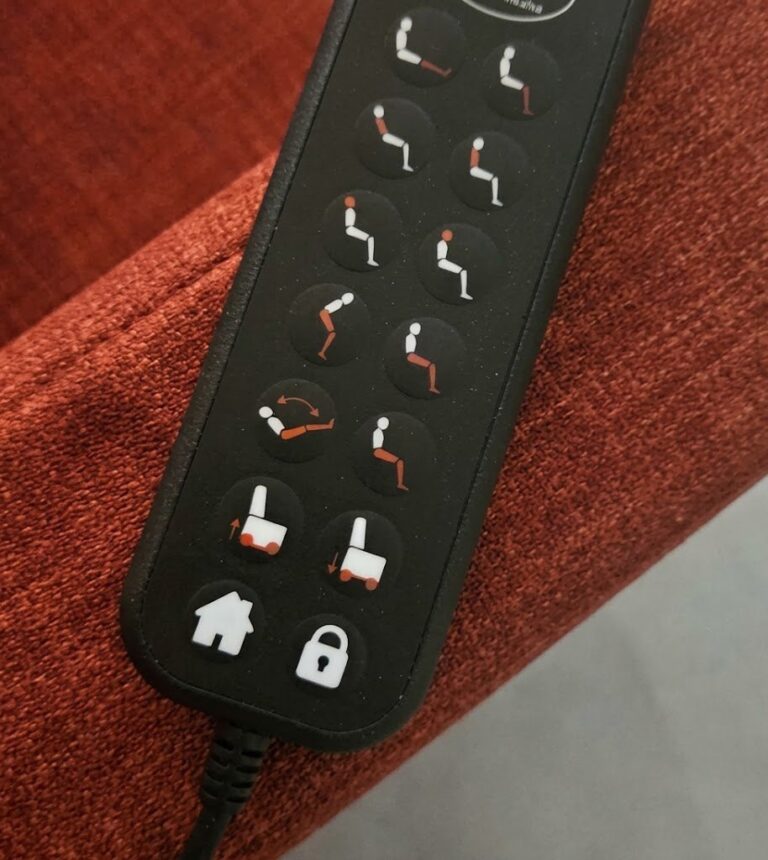
Weak or painful hands: 7 checks for riser recliner controls
Sollevita’s wired handset has paired controls, position symbols and dedicated Home and lock buttons. For people with weak or painful…
Read article