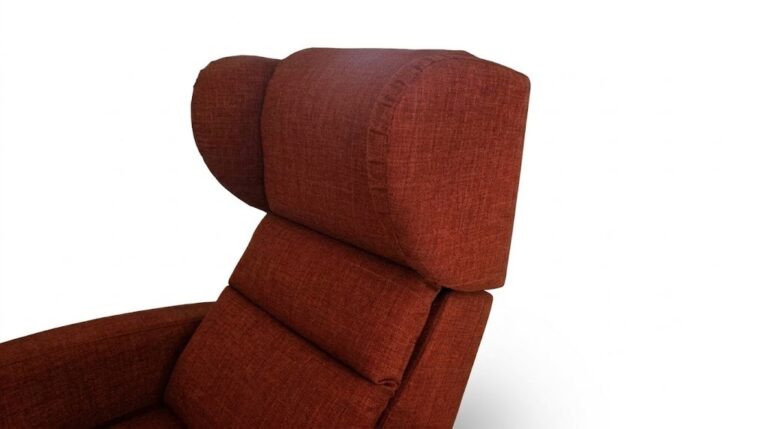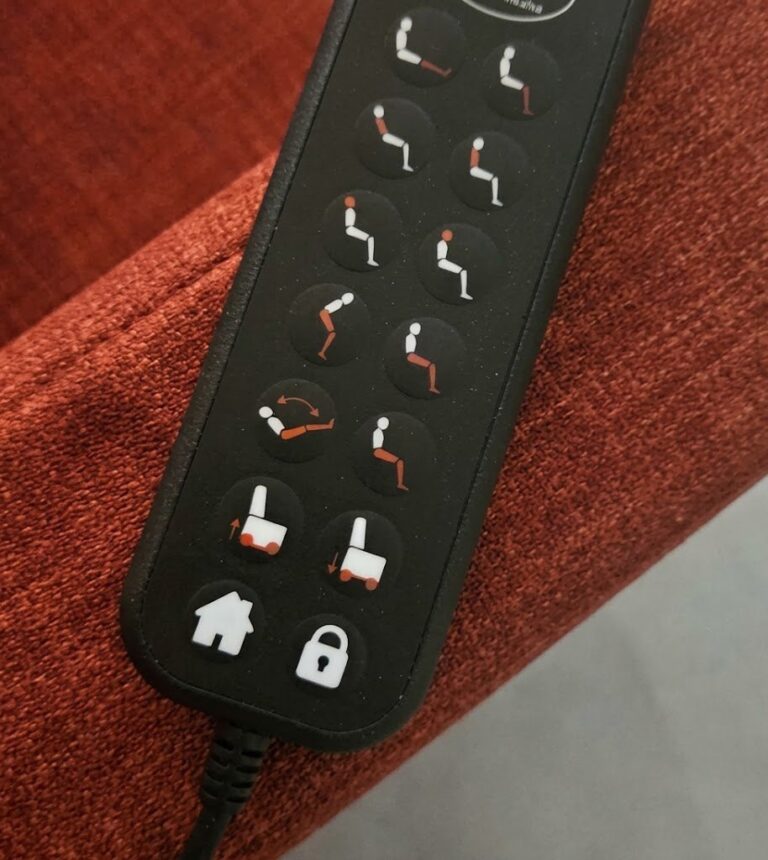
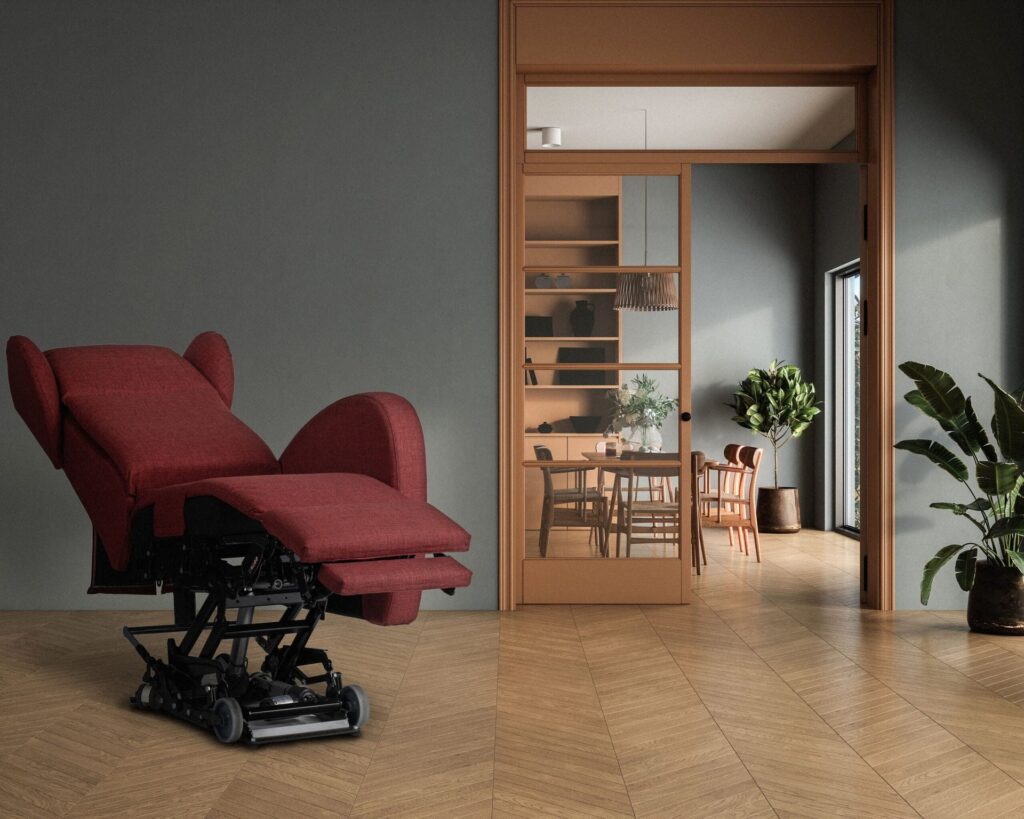
Vertical height adjustment of the chair makes it possible to change the height of the whole chair while the person remains seated or lying down. It can help bring the chair closer to the level of the bed and make activities such as shaving, hair care and dressing more comfortable. For the person providing care, the practical advantage is being able to work closer to the person, without always having to adapt to a low seat. The setting should be chosen to suit the activity, while respecting the support and comfort of the seated person.
In brief
Vertical height adjustment changes the height of the whole chair while keeping the person seated or lying down; the rise function, by contrast, guides the person towards a standing position. For shaving, hair, dressing or compatible massage, the height should be considered together with the space available to approach from the sides. A demonstration based on real activities clarifies the benefit for the person using Sollevita and for the person providing care, including the return to the usual position.
The rise function and vertical height adjustment meet different needs
A chair that helps you stand up does not necessarily offer vertical height adjustment. With the rise function, the pelvis is guided upwards and forwards, preparing the move to standing. With vertical height adjustment, on the other hand, the whole chair rises or lowers while keeping the seated or lying configuration. It is a difference to check by watching the movement, not just by looking at a photo of the end position.
On Sollevita, this feature works together with the 180° lie-flat position and the fully removable side panel. The flat surface can be placed alongside the bed, aiming for a height compatible with the transfer procedure. The same adjustment can then be used to bring the face or upper body to a more comfortable height during personal care. The functions of the Sollevita care riser recliner show these uses within a single product. [3]
The height that suits a transfer does not necessarily match the one that suits shaving. So there is no “high” position to leave set for the whole day: each activity has its own access point and a subsequent rest configuration to consider.
Before raising the chair, look at where the person providing care works
A razor close to the face, a sleeve to adjust and the nape of the neck to reach require different distances. To prepare the trial, describe the task that is currently awkward: “I have to bend down to reach the face” is more useful than “we need a higher chair”.
Suva links smart handling to the use of aids, the person’s available abilities and the training of those providing care. Equipment should be built into the way the work is organised, not treated as a stand-alone solution. [1]
In practice, look at three aspects: the point to be reached, the space to get close and the person’s support. If a side table takes up the working side, raising the chair may still leave the family member at a distance. If the head loses support, a more comfortable height for the person carrying out the activity does not make the configuration suitable.
The person providing care may also change during the day. The setting that works for a tall family member may not be the most comfortable for someone else: it is useful to explain the function to whoever will actually use it, without fixing a single height as a rule for everyone.
Shaving and hair: bringing the task within easy reach
For shaving, head support matters too
During shaving, the height can be adjusted to make the face easier to reach. However, the person should not have to hold their neck in a forced position to make the family member’s task easier. First find a comfortable support, then check whether the height allows you to work close up.
Sollevita’s Push Head powered headrest adjusts the support for the head and neck; it is not an immobilisation device. There is no need to remove the side panel when the height and the backrest position are enough. Keeping useful supports in place is preferable to removing parts without a real need. [3]
For hair, consider the side and the nape of the neck
Combing or cutting hair may require different access from shaving. The person doing the work must be able to change position around the chair without leaning over the person seated. Removable parts can be useful, provided the configuration remains suited to the support needed.
An electric riser recliner does not become a station for washing hair under running water. Liquids, tools and products should be handled according to the instructions for the product and the upholstery. Prepare what you need beforehand and put the tools away before starting a new movement.
Dressing and massage: when a free side and a flat surface are needed
When dressing, a common difficulty is reaching the far side to adjust a top or a sleeve. Clearing access can let the person providing care approach from the relevant side, instead of working with outstretched arms. Removing the side panel should nevertheless be assessed if the person needs lateral support.
On Sollevita, the removable upper armrest section and the fully removable side panel serve different purposes. The first can make it easier to get close to the table; the second frees the side of the seat for care and some transfers. Neither is a licence to drag the pelvis or to bear the person’s weight on your own. [3]
For a compatible massage, the 180° lie-flat position and vertical height adjustment make it possible to bring the flat surface to a more comfortable height. The person giving the massage can thus assess access and working position without needing to change to another surface just to have a higher one.
Not all treatments are compatible: the person’s position, the pressure applied and the need for support must be assessed by the professional. Sollevita should not be regarded as a universal professional treatment couch. Creams and oils must also be compatible with the chosen upholstery.
A table to help you choose what to try
This table helps you prepare a demonstration. It does not assign standard heights and does not describe handling techniques: it links an activity to the feature that needs checking.
| Activity | What to check | Sign of a useful trial |
|---|---|---|
| Shaving and facial care | Seat height and head support | The face can be reached without forcing the person’s neck |
| Combing and cutting hair | Access to the nape of the neck and space around the chair | The person doing the work can get close to the side needed |
| Dressing | Side access and supports to keep in place | Clothing can be reached without leaning over to the opposite side |
| Compatible massage | Flat surface, height and supports | The professional confirms a suitable working position |
| Table activities | Space taken up by the armrests, clearance under the table and supports | The person gets close without knocking their knees or the frame |
| Bed-to-chair transfer | Height, side, aids and working space | The configuration is compatible with the procedure already defined |
For each row, add who carries out the activity and what obstacle they face today. A note such as “the bedside table blocks the left side” is already useful information: it stops you expecting the chair’s mechanism alone to solve a space problem.
In transfers, compatibility matters, not just height
Vertical height adjustment can reduce a difference in level between surfaces, but you also need to consider the approach, the access side, the space for aids and the return from the chair to the bed. A configuration that is comfortable in one direction only does not describe the whole routine.
The 180° lie-flat position, vertical height adjustment and the removable side panel are the features Sollevita uses to prepare for positioning alongside the bed. The weight capacity goes up to 340 kg in the dedicated configuration; the seat width is 52 or 63 cm, with three seat depths available. On their own, these figures do not prove compatibility with a specific bed or patient hoist. [3]
If a patient hoist is already part of the plan, it should not be set aside just because the chair reaches a favourable height. Transfer boards, slide sheets and hoists perform different tasks and must be chosen and used according to the assessment of the person and the specific instructions. Suva in fact distinguishes aids for different activities, including standing assistance as opposed to a transfer with a hoist. [4]
When positioning the chair alongside the bed, what matters is the stable configuration set out in the manual. Transfers should not be improvised while the chair is free to roll on its wheels.
A trial with three activities, without testing anyone’s endurance
Choose three recurring tasks: for example, combing hair, adjusting a sleeve and preparing to position the chair alongside the bed. For each one, describe the current situation; there is no need to repeat a painful or risky manoeuvre to document it.
Before the demonstration, get the items ready, clear the side needed and agree who will operate the controls. During the trial, check two results together: the person keeps comfortable support and the person providing care can get close to where they need to work. The highest setting is not automatically the best one.
Finish by returning the chair to the configuration suited to the next activity and making the controls accessible again. This step is as important as the initial adjustment, especially when several family members take turns.
Observation form to fill in: activity; current difficulty; person providing care; adjustment tried; supports to keep in place; result as perceived by both; question to clarify. It is an organisational tool, not a validated clinical or ergonomic assessment.
When the function is useful and when something else is needed
Vertical height adjustment is worth considering when care is often carried out on a seat that is too low, when the height needs to be brought closer to that of the bed or when activities require access to different areas of the body. It can also be useful for an independent person who receives a compatible massage or wants an adjustable surface for personal care.
It is not enough, however, when the person providing care has to hold much of the person’s weight, when adequate supports are lacking or when the space does not allow the necessary aid to be used. The problem is not solved by increasing the height or removing both side panels.
Adjusting the height can reduce some bending and the need to work with outstretched arms. For the person providing care, access and the chance to change position also remain important: Suva draws attention to prolonged static activities. Raising the surface does not remove the need to alternate postures. [2]
Measurements, cleaning and controls are part of the same choice
On Sollevita, the adjustments are driven by 5 to 8 independent motors, according to the weight capacity. The high backrest, the Push Head and the three-layer seat construction complete the support; choosing the right seat depth remains essential, so that the motors are not asked to compensate for a seat that is out of proportion. [3]
Because both covers are fully removable, the outer cover and the underlying cover can both be taken off. The Raggio di Sole or Mons fabrics and the faux leather require care consistent with their respective instructions. Ease of removal does not mean that any detergent or disinfectant is suitable.
For the consultation, the user’s height and weight, the priority activities, the aids in use and photographs of the space are enough to begin with. To show the position of the person providing care, a demonstration with the chair empty may be sufficient. There is no need to share health data or to repeat complex transfers in order to make a video.
FAQ
Common questions
Is the chair’s vertical height adjustment useful even without standing up?
Yes. It adjusts the height of the whole chair with the person seated or lying down. It is precisely this feature that makes it useful for positioning alongside the bed and in some care activities, regardless of whether the rise function is used.
Do I need to remove the side panel for shaving?
No, not necessarily. The height and head support may be enough. The side should be cleared only when it is really needed and when the person keeps the necessary supports. The Push Head adjusts the support; it does not immobilise the head.
Is there a correct height for every caregiver?
No. It changes with the height of the person providing care, the area to be reached and the user’s position. The trial should check comfort for both, access and the possibility of returning to the usual configuration.
Can the chair replace a patient hoist?
Not automatically. The adjustable height and the open side can make it easier to prepare the transfer, but they do not replace the aid planned for the person. Compatibility must be checked with the bed, the hoist and the staff involved.
Can the flat position be used for a massage?
Yes, for compatible activities assessed by the professional. The 180° lie-flat position and vertical height adjustment provide a flat surface at a variable height. Supports, access, type of treatment and instructions for use still need to be checked: it is not equivalent to every professional treatment couch.
What should I send to the Sollevita Team before the trial?
Describe three activities, the side used, the person’s measurements and the aids in use. Add photos of the room and any questions the person providing care may have. To get started, there is no need to film the person or to carry out manoeuvres that are already difficult.
Reference sources
[1] Suva, Smart handling in care and support work (in Italian). General principles on aids, organisation and training. Open the source
[2] Suva, Static strain (in Italian). Ergonomic adaptation of activities and alternating postures. Open the source
[3] Sollevita, care riser recliner: technical data, vertical height adjustment, side access and construction. Open the source
[4] Suva, Smart handling: providing suitable aids (in Italian). The different tasks of aids and the need to choose them for the activity. Open the source
Start from the caregiver’s activities
Identify the tasks that currently require the most bending or involve difficult access. In the Sollevita for mobility and care needs section you will find the path closest to your situation; share the completed form with the Sollevita Team so that height, supports and space can be assessed in your actual situation.