
A chair that helps caregivers should be assessed over the course of the day, not only during a demonstration. It can make some activities more accessible and allow the person to adjust their position with less help, when they are able to. To understand where it would be useful, it is worth distinguishing requests, physical effort and interruptions. A three-day diary helps describe them: it does not measure how good the person providing care is, and it does not establish how many hours of care could be cut.
In brief
To understand how to lighten the routine of the person providing care, the reason behind the requests matters as well as their number. A short activity can be demanding, and being continuously available is not the same as manual work alone. The three-day diary records usual episodes, without trying anything new: it helps distinguish where supports, controls or vertical height adjustment can be useful and where other help and rest periods are still needed.
The care workload cannot be measured by the clock alone
Preparing lunch, helping someone change position and staying available while they rest are not the same activity. They can take similar amounts of time but call for different levels of attention, organisation and physical involvement. Writing a generic “care all day” conveys the overall fatigue, but it does not show where to start improving the routine.
Among the difficulties of informal care, Eurocarers points to prolonged commitment, unpredictability and constant vigilance, as well as the consequences for personal life. It is therefore wrong to promise that a mechanical function will, on its own, resolve the family member’s workload. [1]
For a first observation, separate three aspects: the task carried out, the presence required and what interrupted another activity. Time spent on a conversation the person wants, for example, should not be treated as waste to be reduced. The quality of the relationship remains part of the day, even when the product makes an adjustment simpler.
Before observing, agree on what matters to the person
The diary works better if the person receiving care knows why it is being kept. The aim is to find more comfortable and better-organised situations, not to make them feel responsible for the tiredness of those close to them. When they are able to express themselves, ask them which activities they would like to manage differently and which kinds of help they want to keep.
Choose three days from the usual routine. They can be consecutive or include times with different carers; note this down, because comparing across changes of people and setting calls for caution. Do not wait until the diary is finished to ask for help if a step has already become unsafe.
The diary helps prepare a conversation, without assigning scores or diagnoses. In the pages dedicated to specific needs you will find the general picture; here, instead, we look at the concrete activities around the seat and what makes them demanding.
Three-day diary: record episodes, not every minute
Brief notes after the activity, when there is time, are enough. There is no need to time the person or to fill in the sheet during a transfer. If the day is very busy, record only the most demanding episodes and note that the diary is partial.
| Field | What to note | Example description, not a real case |
|---|---|---|
| Day and time | A recognisable part of the day | After lunch, day two |
| Request or activity | The concrete reason for the help | Reaching the remote control |
| Help given | What needed to be done | Picking up the dropped handset |
| Participation | What the person managed | Chose and operated the adjustment |
| Obstacle | Object, position, space or uncertainty | Side surface too far away |
| Perceived effort | Free description, no scale | Short, but repeated several times |
| Follow-up check | Who to ask | Position of the handset to be reviewed |
Add the time only if you can estimate it without difficulty and with the same criterion across all three days. You can write “a few minutes” or note that the activity is repeated often: there is no need for precision that is hard to reconstruct from memory.
The example rows show how to write entries; they do not describe a result obtained with Sollevita. There is no need to include names, diagnoses or intimate information to describe a mechanical or organisational obstacle.
Reading the diary: four questions before looking for a function
Is the request about an object or a movement?
If the problem is retrieving water, glasses or the remote control, the first answer may be to place things differently. Adding a motor does not bring an object left out of reach any closer. If, instead, the angle of the chair needs changing frequently, check whether the handset is easy to understand and use.
Is help needed, or is an explanation missing?
A family member may step in because the button was not recognised, not because the person has lost the ability to use it. This does not mean leaving them to try on their own: it means distinguishing learning how to use the product from the personal care that must continue.
Is the work done too far away or too low?
Shaving, arranging clothing and hair care may require different kinds of access. The position of the furniture next to the chair can matter as much as the height of the surface. Record the activity and the difficult point, without experimenting with holds or ways of moving the body.
Is a technical solution needed, or more human support?
Broken nights, having no one to take over and difficulty leaving the person are not problems that a seat alone can solve. The Swiss Federal Office of Public Health (FOPH) treats support for family carers as a set of information and services, not as a single piece of equipment. The resources available should be looked for in your own area. [2]
What a chair can change in the routine
Sollevita incorporates from 5 to 8 independent motors, depending on the weight capacity. This figure matters when it lets you link an adjustment to an activity, not when it is used to promise an automatic reduction in workload. [3]
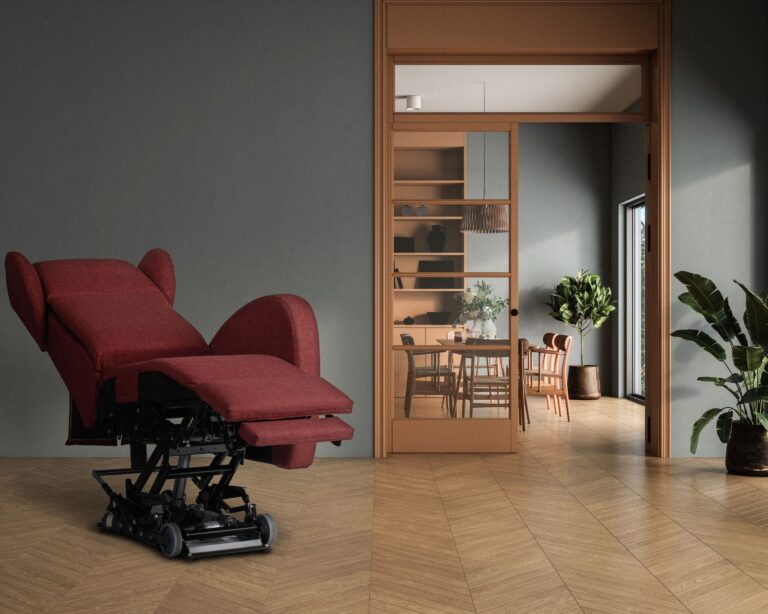
Vertical height adjustment raises or lowers the whole structure while the person stays seated or lying down. It can bring the surface to a more comfortable height for compatible personal care activities. The rise function, on the other hand, supports the movement towards a standing position: they are not two names for the same movement.
The fully removable side panel frees up access from the side; the removable upper armrest section mainly helps with getting closer to the table. Being able to get closer, however, does not justify changing the transfer technique or reducing the planned staffing.
The Push Head powered headrest, backrest and footrest offer adjustments for supporting the body. If the person can operate the handset, they can choose some positions without asking for a manual adjustment each time. If they cannot, appropriate help is still needed. The description of Sollevita’s functions lets you distinguish these possibilities before the consultation.
Do not forget the cleaning and maintenance work
Less obvious activities may appear in the diary: removing a protective cover, cleaning after a meal, tidying cables, setting up the charging point. These tasks contribute to overall practicality and do not disappear when you buy a more complete chair.
On Sollevita, both the outer and the underlying covers are removable, and together with the removable components this makes cleaning and handling individual parts easier. The instructions for the chosen upholstery explain how to wash and dry it correctly, avoiding unsuitable products or treatments. [3]
Also note who knows how to carry out each task and where the instructions are kept. A procedure that is simple for one person may be unclear to an occasional carer. The solution may be a tutorial or an explanation from the Sollevita Team, not a technical modification.
Comparing two situations without promising minutes saved
After an agreed change, you can observe the same activity again: is the handset still within reach? Can staff access the side they need? Is the person still happy with the activity? These are more useful questions than a generic promise of “saving time”.
Note what has changed: the position of the chair, the explanation of the controls, the presence of a carer or the circumstances of the day. If several things change at once, do not attribute the whole result to the product. Even a perceived improvement should be described for what it is: an individual observation.
When a function saves the person from changing seats just to reach another room, the route and the way the move is made must also be assessed. Sollevita’s manually moved wheeled base is for short moves indoors with the person seated; it does not remove the need for the help required to push it. [3]
When the diary should lead you to ask for help
If improvised manoeuvres, pain during care or difficulty ensuring the required presence come to light, do not wait for a new chair before talking to the relevant professionals. The diary can explain the problem, but it does not justify repeating a step that is no longer manageable.
Likewise, a drop in calls is not a positive result if the person stops asking for help so as not to be a bother. Being able to express a need and receive a response remains essential. A better routine must also be recognised as such by the person receiving care.
The expression “24/7 care” describes a need for continuity: it does not mean that a chair can provide supervision, cover a shift or, on its own, guarantee safety at night. This is why the technical choice must go hand in hand with organising help, without confusing the two responsibilities.
FAQ
Common questions
Does a chair that helps caregivers always reduce care hours?
No. It can make certain activities simpler, but it does not determine the number of people or hours needed. These depend on the actual situation. The diary is for identifying difficulties, not for justifying a reduction in care.
Do I have to record every request for three full days?
No. You can focus on one part of the day or on the most demanding episodes, noting that the observation is partial. Do not give up necessary care in order to fill in the sheet, and do not aim for artificial precision.
Does vertical height adjustment eliminate physical effort?
Not automatically. It can bring the working point to a more comfortable height, but access, the activities, the person’s abilities and aids all still matter. The benefit should be assessed on the specific task, keeping to the training and the agreed procedures.
Do fewer calls mean greater independence?
Not always. You need to understand why the calls have decreased. The person may be managing the handset better, but they may also have given up asking for something. Their point of view should be gathered alongside the observations of the person providing care.
Is the diary a scale for measuring a family member’s stress?
No. It is a practical sheet that has not been clinically validated. It does not produce a diagnosis or a burden score; it can help describe episodes to the appropriate professional and technical needs to the Sollevita Team.
What information should I send to the Sollevita Team?
The priority activities, the obstacles encountered, useful measurements and the aids already in place. Share only the information and images that are necessary, with the involvement of the person. For health problems, the professional who looks after them remains the point of reference.
Reference sources
[1] Eurocarers — Physical & mental health exploring the implications of informal caregiving
[2] Swiss Federal Office of Public Health (FOPH) — Relatives providing support and care (in Italian)
[3] Sollevita / La Castellana — Riser recliner chair with integrated care features: functions, construction and technical data
Prepare your questions about the most demanding activities
Gather a few observations on the activities you would like to make simpler and discuss them with the Sollevita Team. The Sollevita support and after-sales service page clarifies what the product can do; human support and professional guidance remain part of the decision.