ALS AND MOTOR NEURONE DISEASES
Riser recliner chair for ALS: when loss of strength changes posture and care
A riser recliner chair for ALS enters life at home through concrete needs: being comfortable during a conversation, supporting head and trunk, changing the supports or preparing a transfer. The choice also takes in the controls, communication aids and the help available, keeping the preferences of the person at the centre.
Sollevita is a riser recliner chair with integrated care features, made in Italy by La Castellana. It brings together adjustments for resting, sit-to-stand assistance, vertical height adjustment and side access. It offers a place at home for comfort and care, including next to the bed and the wheelchair, to be organised with the supports required.
Sollevita is also designed for people who keep independent activities and want more everyday wellbeing, not only for those who need continuous assistance. In amyotrophic lateral sclerosis, needs do not follow the same order for everyone: the starting point is what the person wants now and the guidance received. The chair supports activities, without curing the disease or replacing the clinical pathway.
On this page
- In ALS the way the day is organised changes
- Choosing for today, with attention to needs that change
- Measurements and supports: assess the whole seat
- Head support: Push Head offers an adjustable rest
- Powered adjustments and intuitive handsets
- Adjusting the chair, communicating and asking for help
- Standing up and sitting back down when moving into standing is appropriate
- Rest and positions: respecting respiratory guidance
- Bed-to-chair transfers and the lie-flat transfer configuration
- Wheelchair, wheeled base and daily care
- Swallowing, communication and devices must coexist with the chair
- A product to manage and review over time
- The eight Sollevita functions, already integrated
- What to tell the Sollevita Team before the consultation
- Answers on support, controls and care in ALS
In ALS the way the day is organised changes
Loss of strength does not affect everyone in the same order. For one person it soon becomes difficult to raise the arms or hold the head; for another the main problem is standing up, turning or transferring. The pace of change varies too, which makes it necessary to look at daily life rather than at a predetermined sequence.
One person may still be independent when seated and need help only to change a support. Another may use a wheelchair and be looking for a second place at home for resting. Another may be transferred with a patient hoist. The same diagnosis therefore does not produce one single valid configuration.
The starting point is understanding which activity the chair should make more manageable: a conversation with the head supported, a break with the legs resting, or easier access for care. The new seat has to find a place in the day without taking away what already works.
Choosing for today, with attention to needs that change
In ALS it makes sense to think about how long the product will serve and about the possibility that needs will change. That does not mean assuming that every function will certainly be used. It means comparing present needs and those already identified with the professionals involved, without turning a generic prediction about the disease into a purchase decision.
Sollevita is complete from the start and makes it possible to use the relevant adjustments while leaving other possibilities available. When reading the construction and functional differences of Sollevita, consider movements, measurements, access and construction together. Value cannot be worked out just by counting motors or comparing photographs of final positions.
The integrated adjustments keep several possibilities available. If head support, tolerated positions or transfers change, how the chair is used is reviewed with the professionals involved and with the Sollevita Team: an informed choice also considers the equipment that must continue to be present.
Measurements and supports: assess the whole seat
Support for the head also starts from how pelvis, back and arms are settled. A seat that looks soft may not offer the supports you want if it is too deep or if the armrests end up far away. The chair should therefore be assessed as a whole, rather than choosing the headrest first and leaving the measurements until last.
Sollevita offers seat widths of 52 or 63 cm and three depths, obtained through the positioning of the backrest. The three-layer seat construction combines a sprung seat base, individually pocketed springs and an upper comfort layer. The high backrest and the footrest extension complete the support options.
Any specialist cushions and supports are part of the configuration to consider. They should not be left out of the discussion because the chair already seems comfortable, nor assumed compatible without checking. Sollevita is not a pressure-relief surface: where the risk of pressure injuries has to be managed, surface, care and changes of position follow an individual assessment.
Head support: Push Head offers an adjustable rest
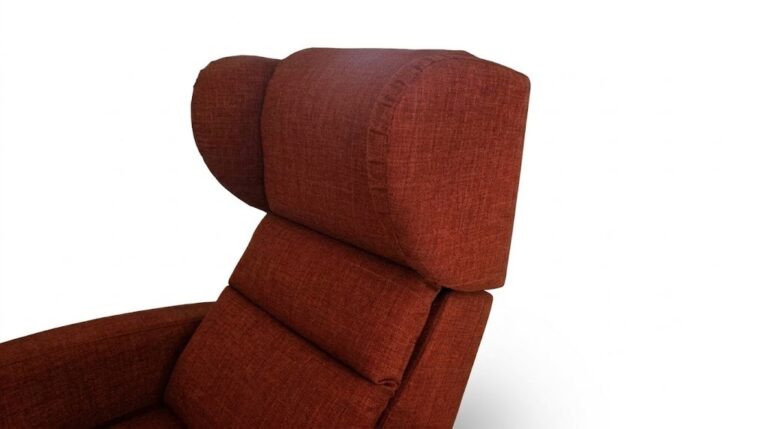
The powered headrest Push Head changes the support for head and neck and makes it possible to adapt it to the position in use. The high backrest follows the back along its length, with firmer support in the lumbar area and a softer feel higher up. The adjustments can stop at intermediate positions.
During a conversation, while reading or resting, the usefulness to assess is concrete: does the head find support compatible with the activity? Does the gaze stay directed towards the other person or the screen? The trunk and the aids already in use need to be considered too, without asking the headrest alone to compensate for every difficulty.
Where holding the head requires a specific collar or lateral support, Push Head is not an automatic substitute. It adjusts the support, but it does not on its own recover a head that has dropped forward and it does not treat weakness of the neck muscles. Any supports required should be defined with whoever follows the person.
Powered adjustments and intuitive handsets
As strength decreases, even raising the legs or changing the backrest can call for help. The powered adjustments on Sollevita make it possible to change the angle, open the footrest and adjust Push Head through the handset, without operating manual levers. The help concerns these movements of the chair, not every movement of the body.
Moving the structure is not the same as repositioning the person. If the pelvis has slid or the trunk has lost support, the care procedures planned should be followed. Greater recline should not be used as an attempt to correct a support that is not right.
Sollevita handsets are designed to be simple to use, with intuitive buttons in a logical layout. Corded and wireless versions are available: the choice is made with the Sollevita Team, taking into account the configuration, habits and any help from a carer. Where hand strength calls for support, the most convenient way of managing the adjustments is agreed together.
Adjusting the chair, communicating and asking for help
A person may no longer be able to use the handset and still express precisely how they want to be positioned. That is why the assessment separates control of the motors from communication and from being able to call for assistance.
- Controlling the chair — Make clear who reaches the handset, starts the adjustment and stops the movement.
- Communicating a choice — Keep available the means by which the person expresses preferences, discomfort or a request to change position.
- Asking for help — Check that the usual call system remains usable during rest too and that the assistance planned is available.
Where augmentative and alternative communication aids are used, such as an eye-controlled communication device, the position in relation to the face, the mountings and the supports all need to be considered. After an adjustment it may be necessary to check accessibility again with the relevant specialist.
The usual call system remains available alongside the controls of the chair. Any specialist integration with communication aids or other devices requires a dedicated check: having a wireless handset does not imply that those devices control the motors.
Standing up and sitting back down when moving into standing is appropriate
A riser recliner chair for ALS offers help with the move into standing when that activity is appropriate for the person. Sollevita progressively guides the pelvis upwards and forwards, with the supports and the assistance planned. The movement fits into the procedures already agreed with whoever follows mobility.
The movement can be stopped along the way; in reverse it can accompany the return to the seat. This possibility should not be read as a system that detects a fall. The supports and the help planned must remain available even when the powered movement is gradual.
If the usual transfer happens with a patient hoist, there is no need for a standing trial in order to assess the other functions of Sollevita. Increasing the angle of the rise does not replace full support of the body. Any change to the procedure is agreed with the professionals involved, not tried out during a product demonstration.
Rest and positions: respecting respiratory guidance
Backrest, footrest and Push Head offer adjustments for resting. Tilt-in-space tilts seat and backrest together, keeping the angle between them; backrest recline, on the other hand, changes the angle between the two parts. Both change the position and must be assessed together with the supports and the guidance received.
The lie-flat position (180°) makes it possible to stretch out in the same place where that use is appropriate. Intermediate angles remain important: in ALS, breathing difficulties or ventilation equipment can make a setting other than fully horizontal necessary. There is no need to reach the maximum angle simply because it is available.
Zero Gravity offers a relaxed setting with legs and feet raised. It is not a treatment for breathing problems and it does not replace prescribed support. A position that feels pleasant at first should still be checked against the needs of the person, without attributing an automatic clinical benefit to it.
A new breathing difficulty calls for medical advice, not a series of attempts with the handset. The positions agreed must also be respected during the moves in and out of the chair, not only once everything is settled.
Bed-to-chair transfers and the lie-flat transfer configuration
When the need concerns moving between surfaces, Sollevita coordinates three possibilities: the lie-flat position (180°) creates a flat surface, vertical height adjustment changes the height of the whole structure and the fully removable side panel frees up the side. Vertical height adjustment is distinct from the rise function: it can move the chair with the person seated or lying down without guiding them into standing.
The lie-flat transfer configuration makes it possible to prepare the approach to the bed and can reduce some height differences and obstacles. Before using it, the appropriateness of the flat position planned should be checked. Finding a comfortable arrangement on arrival is not enough: the route to get there must also respect individual guidance.
When a patient hoist is used, the check concerns the actual model, the dimensions, the access and the configuration of the chair. Not every transfer with a hoist requires bringing the seat into the lie-flat position first. The actual procedure remains the one defined for the person and for the equipment in place.
The lie-flat transfer configuration does not lift the person out of the chair and does not replace slings, slide sheets or other equipment required. The outward and return moves should be considered separately, together with the carer and the devices that must remain available. Opening the side prepares a space; it does not determine a universal technique.
Wheelchair, wheeled base and daily care
The wheelchair may keep a central role in mobility and in personalised supports. Sollevita can sit alongside it as a second place at home for resting and care. The question to answer is which activity the chair adds, while keeping what already works in the wheelchair.
The removable side panel and the adjustable height can prepare side access between the two surfaces. The choice must also consider the return to the wheelchair and restoring the supports required. Managing to reach the new seat once is not enough to judge how useful it is through the day.
The sturdy wheeled base allows accompanied moves between rooms of the home, including longer routes, with the person staying seated. Joining a conversation in the living room or reaching another room therefore does not require a change of seat just to move. Dimensions, route and product instructions still have to be respected. The battery powers the adjustments, not the drive of the wheels; use remains indoors.
Vertical height adjustment brings the person to a more comfortable height for dressing, adjusting clothing, shaving, hair care or compatible massage. Side access allows the carer to come closer and organise the work with less bending, while keeping appropriate supports and ways of helping.
Swallowing, communication and devices must coexist with the chair
The setting should be assessed together with what the person uses: head supports, communication aids, respiratory devices and their connections. Leaving space is not the same as demonstrating compatibility. The actual product, where it sits and what happens in the positions planned all need to be clarified.
With the relevant clinical and technical specialist, accessibility, mountings and the routing of connections are checked during the movements of the chair as well. Devices are not moved, disconnected or fixed by trial and error to complete a demonstration. The Sollevita Team describes the structure and the adjustments; whoever looks after the device checks how it is used.
Universal fittings, electronic integration or power supply for ventilators and communication aids should not be assumed. The battery of the chair serves its own adjustments: it is not a power reserve for respiratory devices. These points must be clarified before use, not inferred from the presence of space or of a socket nearby.
To come closer to a compatible table, the upper part of the armrest can be removed: that is different from removing the whole side panel. Talking, using a screen and eating do not necessarily require the same position. Where there are swallowing difficulties, supports, the way meals are given and assistance follow the guidance received; the headrest is not a manoeuvre to make swallowing easier.
A product to manage and review over time
When the chair is part of the day, managing the covers and being able to get explanations matter too. Both the outer and the underlying covers are removable. The modular construction allows work on the individual parts provided, while care and the tasks done by the user follow the product instructions.
Sollevita comes with five years of commercial warranty on every element, according to the conditions of purchase, original spare parts and direct support with tutorials and video calls. The Warranty & Service page brings together cover and arrangements, so the family keeps a clear point of reference after delivery too.
If several people take turns helping, it is useful to share the explanations of the movements and to know who keeps the manual and the details of the configuration. A change in needs should be discussed with the professionals involved; a problem with the control or the mechanics should be reported to the Sollevita Team. Technical support and clinical care work together, but they remain distinct tasks.
The eight Sollevita functions, already integrated
Sollevita is a single complete model: the eight main functions are part of the same design. The drive system includes between 5 and 8 independent motors, depending on the user weight rating. The adjustments make it possible to assess seating, resting and care in one chair; how they are used remains what is appropriate for the person.
- Rise function — Accompanies the move towards standing and, in reverse, the return to sitting.
- Relax — Adjusts backrest and footrest for a conversation, television or a break, including intermediate positions.
- Powered headrest Push Head — Adjusts the support for head and neck in the different positions.
- Tilt-in-space — Tilts seat and backrest together, keeping the chosen angle between the two parts.
- Zero Gravity — Offers a relaxed setting with legs and feet raised, to be assessed against the supports and individual guidance.
- Lie-flat position (180°) — Brings the chair into a flat position for resting, where that position is appropriate.
- Vertical height adjustment — Raises or lowers the whole structure with the person seated or lying down, setting the height for care and for coming alongside.
- Lie-flat transfer configuration — Combines flat surface, vertical height adjustment and removed side panel to prepare the approach to the bed and some transfers.
The design also includes the three-layer seat construction, the high backrest, the footrest extension, the removable upper armrest sections, the removable side panel, the lithium battery and the wheeled base. Removable backrest, armrests and wings, removable outer and underlying covers and modularity complete the management of the product over time.
See functions, measurements and price of Sollevita to get to know the configuration and look further into the features most useful for your day.
What to tell the Sollevita Team before the consultation
To choose a chair for amyotrophic lateral sclerosis, tell us how you would like to use it: a conversation with the head supported, a break in the living room or easier access for care. Supports, height, weight, equipment and the guidance already available help to prepare a concrete discussion.
We can also talk about the handset you prefer, who will use the adjustments and the usual ways of communicating a choice or asking for help. For the wheelchair, the patient hoist and other devices, the technical details and the relevant guidance are enough: there is no need to share a complete medical file.
You can start from photographs of the empty space and from an explanation of the functions. Any personal trial respects the positions and the assistance indicated, without tiring the neck or repeating movements to demonstrate a difficulty. The Sollevita Team guides you through the technical choice, in dialogue with the professionals involved.
3 steps to define the perfect Sollevita for you
Sollevita comes fully equipped for home care. Our job is to understand whether it can meet your needs and to guide you clearly before, during and after delivery.
Tell us about yourself
Tell us about your needs, or those of the person who will use Sollevita. Height, weight, hours spent in the chair, level of independence and daily needs help us understand how the product will be used every day.
Let's assess together whether Sollevita is right for you
The Sollevita Team listens to your needs, explains every function and assesses sizes, weight capacity and how the chair will be used. We explain precisely whether and how Sollevita can meet the needs of the person and their daily life.
Delivery and support
We arrange delivery and a complete explanation of the product, so that you get to know all of Sollevita’s functions and use them correctly. After purchase, the Sollevita Team remains your direct point of contact for warranty, spare parts, tutorials, video calls and technical support over time.
Next step
The right choice starts with a conversation
For such an important choice, talk to the people who make it. Write to us: you will get a reply directly from the Sollevita Team, not a call centre. Our consultants know the chair inside out, from its mechanisms to its adjustments, and they listen to you to offer clear explanations, technical expertise and personalised advice.
- Free consultation
- Reply within 24 hours
- Direct contact with the manufacturer
FREQUENTLY ASKED QUESTIONS
Answers on support, controls and care in ALS
What the chair can do needs to be connected with present abilities and with the equipment already in use. Head, hands, rest and transfers each call for specific attention, without assuming the same sequence for everyone.
How should Sollevita be assessed if needs may change over time?
The starting point is current activities, the supports and the needs already identified with the professionals involved. The integrated functions offer different possibilities, but they do not guarantee that the chair will answer every future change. If head support, use of the controls, tolerated positions or transfers change, the configuration and any other equipment required should be reassessed.
How does the powered headrest help when holding the head is tiring?
Push Head adjusts the support for head and neck together with the high backrest. It can allow different support for conversation and rest, to be assessed with the trunk and the aids in use. It does not automatically reposition a head that has dropped forward and it does not replace a specialist collar. The benefit concerns adjustable support, not treatment of weakness.
How are the movements managed when the hands lose strength?
Sollevita has corded and wireless handsets, designed with intuitive buttons in a logical layout. The Sollevita Team helps in choosing the most convenient control and in agreeing its use with the carer where necessary. The person keeps the ability to indicate their preferences; any integration with communication aids requires a specific technical check.
Which positions should be considered if lying flat makes breathing less comfortable?
The positions agreed with the professionals involved are what counts, without necessarily reaching the lie-flat position (180°). Tilt-in-space also changes the orientation of the body and should be assessed. The attention concerns rest and the positions needed during transfers. A new breathing difficulty should be reported to the centre that follows the person: adjusting the chair does not replace prescribed support.
When should the rise function be used and when should a different transfer be considered?
The rise function can be assessed when moving into standing is appropriate, with the supports and the assistance planned. The reverse movement can accompany the return to the seat. If full support of the body is needed, or the transfer already happens with a sling, increasing the rise does not replace the patient hoist. The procedure is defined by the professionals who follow the person.
How should Sollevita be checked against the patient hoist already in use?
Model, dimensions, access and the configuration of the chair need to be compared with the transfer planned. The removable side panel and the adjustable height can make preparation easier, but on their own they do not prove compatibility. The flat position is not compulsory for every hoist: it should be checked where the procedure requires it, respecting respiratory guidance too. The sling and the assistance required remain part of the move.
How do personal care, communication and the devices present fit together?
The whole picture is assessed: supports, communication aids, respiratory devices, connections and space for the carer. They must remain usable in the positions planned and during the moves. The chair offers adjustments and access, not automatic integration with other equipment. Its handset does not replace the call system and its battery does not power respiratory devices.
Can Sollevita sit alongside a personalised wheelchair?
Yes. Sollevita offers a second place at home for comfort and care, while the wheelchair keeps its role. The choice covers supports, communication and transfers in both directions. The wheeled base allows accompanied moves inside the home; independent mobility in a wheelchair keeps its own value.